
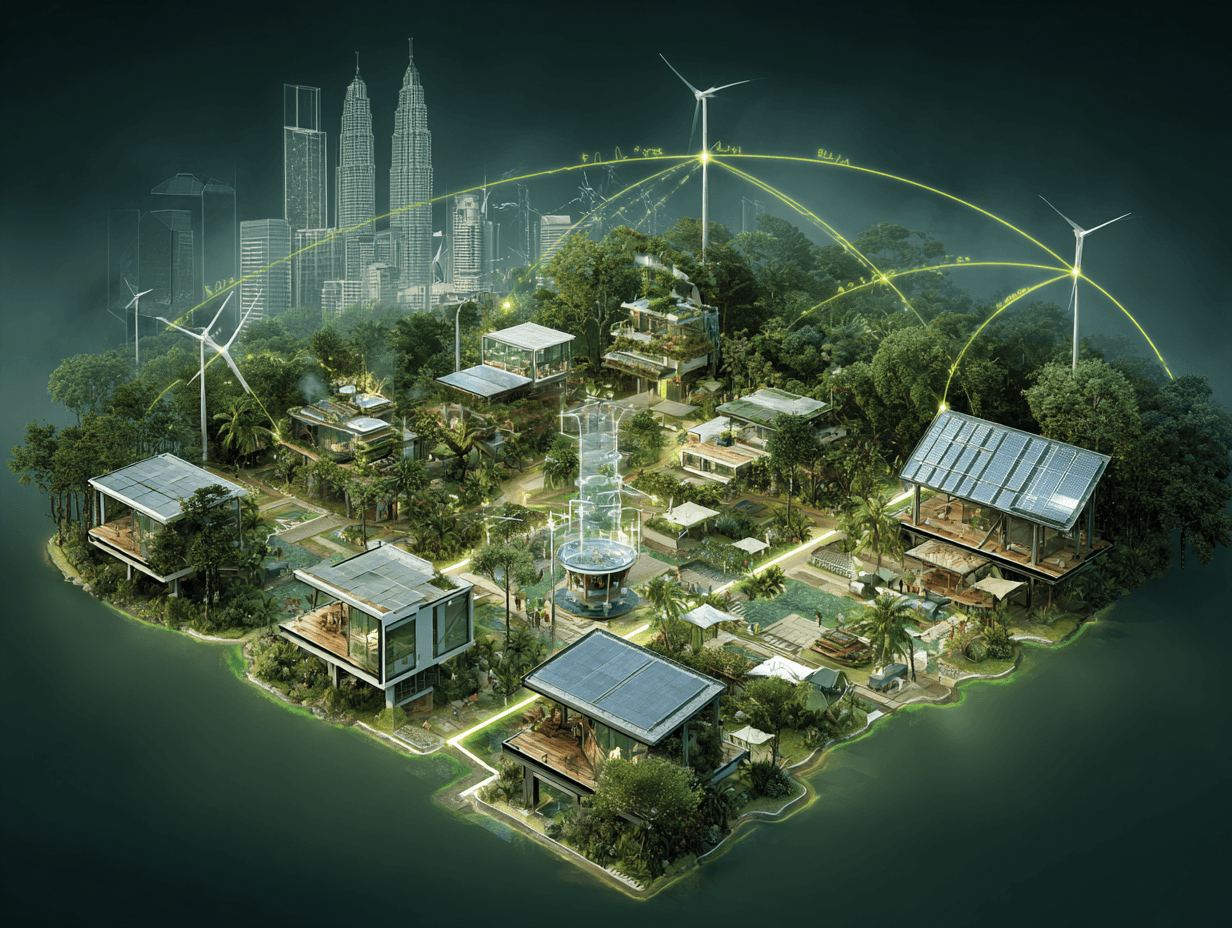
D. Sustainability
From Energy, water, soil, air to plantation and organisms, all forms a nutrition around human—we build a new living & working New Eco City that sustains people with Consensus
Demand
The initial driving force which reflects the need for a
particular product, service, or solution, backed by
purchasing power.
The GAP within the demand sets off the PAD-Integrated
Ecological Industrial Chain
Demand
The initial driving force which reflects the need for a
particular product, service, or solution, backed by
purchasing power.
The GAP within the demand sets off the PAD-Integrated
Ecological Industrial Chain
Demand
The initial driving force which reflects the need for a
particular product, service, or solution, backed by
purchasing power.
The GAP within the demand sets off the PAD-Integrated
Ecological Industrial Chain
If you wish to view the complete project cycle, please refer to Section E
If you wish to view the complete project cycle,
please refer to Section E
Memorandum of Understanding (MOU)
The initial driving force which reflects the need for a
particular product, service, or solution, backed by
purchasing power.
The GAP within the demand sets off the PAD-Integrated
Ecological Industrial Chain
Memorandum of Understanding (MOU)
The initial driving force which reflects the need for a
particular product, service, or solution, backed by
purchasing power.
The GAP within the demand sets off the PAD-Integrated
Ecological Industrial Chain
Primal Analogy Derivation (PAD) System
The PAD model grounds decisions in reality—by sensing physical data
(Primal), linking it to knowledge (Analogy), and deriving logical actions
(Derivation).
Primal Analogy Derivation (PAD) System
The PAD model grounds decisions in reality—by sensing physical data
(Primal), linking it to knowledge (Analogy), and deriving logical actions
(Derivation).
Project Activation Based on Demand and Standard
Initiates on-site deployment in response to verified demand,
following the PAD–NCECDC Standard to ensure alignment
with ecological, operational, and stakeholder requirements
Primal Database
Primal Database stores all unprocessed physical
information, forming the foundation of the PAD
model by grounding all measurable variables
in real-world conditions following the First Principle
Submission of the Implementation Plan
Presents the execution roadmap—including steps,
timelines, and resource allocation—to relevant
authorities, stakeholders, and landowners for
review and coordination.
New-Eco Sustainable Community
A fully integrated, closed-loop urban system that embodies the PAD–NCECDC
framework. It unites nutrition, energy, water, air, soil, and organisms into a
self-regulating, data-driven ecosystem designed for low input, high efficiency,
and circular resource use built on modular infrastructure and decentralized
consensus.
Its core value lies in duplicability—it serves as a scalable, transferable model
that can be replicated across diverse sites to regenerate urban land, activate
local industries, and support sustainable human living.
Primal Sensing
Primal Sensing is the direct sensing of raw physical
variables from the edges of a system—surrounding
a defined goal.
Primal Database
Primal Database stores all unprocessed physical information,
forming the foundation of the PAD model by grounding all
measurable variables in real-world conditions following the
First Principle
Memorandum of Understanding (MOU)
The initial driving force which reflects the need for a
particular product, service, or solution, backed by
purchasing power.
The GAP within the demand sets off the PAD-Integrated
Ecological Industrial Chain
Memorandum of Understanding (MOU)
The initial driving force which reflects the need for a
particular product, service, or solution, backed by
purchasing power.
The GAP within the demand sets off the PAD-Integrated
Ecological Industrial Chain
Memorandum of Understanding (MOU)
The initial driving force which reflects the need for a
particular product, service, or solution, backed by
purchasing power.
The GAP within the demand sets off the PAD-Integrated
Ecological Industrial Chain
PAD Ecological Integrated Industrial Chain
PAD Ecological Integrated Industrial Chain is a closed-loop system that
connects small, decentralized ecological industries—such as energy, water,
and biomass—into a unified chain based on the NCECDC framework.
Primal Analogy Derivation Standard
The PAD–NCECDC Standard is a unified ecological-operational
framework that guides how physical systems, human roles, and
nutrient-energy flows associate together in a decentralized,
self-regulating, closed-loop community.
Primal Analogy Derivation Standard
The PAD–NCECDC Standard is a unified ecological-operational
framework that guides how physical systems, human roles, and
nutrient-energy flows associate together in a decentralized,
self-regulating, closed-loop community.
Primal Sensing
Primal Sensing is the direct sensing of raw physical variables
from the edges of a system—surrounding a defined goal.
Primal Sensing
Primal Sensing is the direct sensing of raw physical variables
from the edges of a system—surrounding a defined goal.
Primal Database
Primal Database stores all unprocessed physical information, forming
the foundation of the PAD model by grounding all measurable variables
in real-world conditions following the First Principle
Analogy Database
Analogy Database stores knowledge associated with the raw data
in the Primal Database. It forms the middle layer of the PAD model,
enabling systems to link real-world conditions with learned experience.
Analogy Database
Analogy Database stores knowledge associated with the raw data
in the Primal Database. It forms the middle layer of the PAD model,
enabling systems to link real-world conditions with learned experience.
Primal Analogy Derivation Standard
The PAD–NCECDC Standard is a unified ecological-operational framework
that guides how physical systems, human roles, and nutrient-energy flows
associate together in a decentralized, self-regulating, closed-loop community.
Submission of the Implementation Plan
Presents the execution roadmap—including steps, timelines, and resource
allocation—to relevant authorities, stakeholders, and landowners for review
and coordination.
Project Activation Based on Demand and Standard
Initiates on-site deployment in response to verified demand, following the
PAD–NCECDC Standard to ensure alignment with ecological, operational,
and stakeholder requirements
Service Operation Integrator
IESASP's role is to bridge technology, resources, and human expertise into a
unified, functioning ecosystem, operate according to the PAD–NCECDC
Standard and remain aligned with real-world demand.
Submission of the Implementation Plan
Presents the execution roadmap—including steps, timelines,
and resource allocation—to relevant authorities, stakeholders,
and landowners for review and coordination.
Submission of the Implementation Plan
Presents the execution roadmap—including steps, timelines,
and resource allocation—to relevant authorities, stakeholders,
and landowners for review and coordination.
PAD Ecological Integrated Industrial Chain
PAD Ecological Integrated Industrial Chain is a closed-loop
system that connects small, decentralized ecological industries
—such as energy, water, and biomass—into a unified chain
based on the NCECDC framework.
PAD Ecological Integrated Industrial Chain
PAD Ecological Integrated Industrial Chain is a closed-loop
system that connects small, decentralized ecological industries
—such as energy, water, and biomass—into a unified chain
based on the NCECDC framework.
Service Operation Integrator
IESASP's role is to bridge technology, resources, and human
expertise into a unified, functioning ecosystem, operate
according to the PAD–NCECDC Standard and remain aligned
with real-world demand.
Service Operation Integrator
IESASP's role is to bridge technology, resources, and human
expertise into a unified, functioning ecosystem, operate
according to the PAD–NCECDC Standard and remain aligned
with real-world demand.
Primal Analogy Derivation (PAD) System
The PAD model grounds decisions in reality—by
sensing physical data (Primal), linking it to knowledge
(Analogy), and deriving logical actions
(Derivation).
Primal Analogy Derivation (PAD) System
The PAD model grounds decisions in reality—by
sensing physical data (Primal), linking it to knowledge
(Analogy), and deriving logical actions
(Derivation).
Analogy Database
Analogy Database stores knowledge associated
with the raw data in the Primal Database.
It forms the middle layer of the PAD model,
enabling systems to link real-world conditions
with learned experience.
Analogy Database
Analogy Database stores knowledge associated
with the raw data in the Primal Database.
It forms the middle layer of the PAD model,
enabling systems to link real-world conditions
with learned experience.
Primal Sensing
Primal Sensing is the direct sensing of raw
physical variables from the edges of a system—
surrounding a defined goal.
Primal Sensing
Primal Sensing is the direct sensing of raw
physical variables from the edges of a system—
surrounding a defined goal.
Primal Analogy Derivation Standard
The PAD–NCECDC Standard is a unified
ecological-operational framework that guides
how physical systems, human roles, and nutrient
-energy flows associate together in a
decentralized, self-regulating, closed-loop
community.
Primal Analogy Derivation Standard
The PAD–NCECDC Standard is a unified
ecological-operational framework that guides
how physical systems, human roles, and nutrient
-energy flows associate together in a
decentralized, self-regulating, closed-loop
community.
PAD Ecological Integrated Industrial Chain
PAD Ecological Integrated Industrial Chain is
a closed-loop system that connects small,
decentralized ecological industries—such as
energy, water, and biomass—into a unified
chain based on the NCECDC framework.
PAD Ecological Integrated Industrial Chain
PAD Ecological Integrated Industrial Chain is
a closed-loop system that connects small,
decentralized ecological industries—such as
energy, water, and biomass—into a unified
chain based on the NCECDC framework.
Service Operation Integrator
IESASP's role is to bridge technology,
resources, and human expertise into a unified,
functioning ecosystem, operate according to
the PAD–NCECDC Standard and remain aligned
with real-world demand.
Service Operation Integrator
IESASP's role is to bridge technology,
resources, and human expertise into a unified,
functioning ecosystem, operate according to
the PAD–NCECDC Standard and remain aligned
with real-world demand.
Project Activation on Demand & Standard
Initiates on-site deployment in response to verified
demand, following the PAD–NCECDC Standard to
ensure alignment with ecological, operational,
and stakeholder requirements
Project Activation on Demand & Standard
Initiates on-site deployment in response to verified
demand, following the PAD–NCECDC Standard to
ensure alignment with ecological, operational,
and stakeholder requirements
New-Eco Sustainable Community
A fully integrated, closed-loop urban system
that embodies the PAD–NCECDC framework.
It unites nutrition, energy, water, air, soil,
and organisms into a self-regulating,
data-driven ecosystem designed for low
input, high efficiency, and circular resource
use built on modular infrastructure and
decentralized consensus.
Its core value lies in duplicability—it serves as
a scalable, transferable model that can be
replicated across diverse sites to regenerate
urban land, activate local industries, and
support sustainable human living.
B. Green Energy
New-Eco Sustainable Community
A fully integrated, closed-loop urban system that embodies
the PAD–NCECDC framework. It unites nutrition, energy,
water, air, soil, and organisms into a self-regulating, data-driven
ecosystem designed for low input, high efficiency,
and circular resource use built on modular infrastructure and
decentralized consensus.
Its core value lies in duplicability—it serves as a scalable,
transferable model that can be replicated across diverse sites to
regenerate urban land, activate local industries, and support
sustainable human living.
New-Eco Sustainable Community
A fully integrated, closed-loop urban system that embodies
the PAD–NCECDC framework. It unites nutrition, energy,
water, air, soil, and organisms into a self-regulating, data-driven
ecosystem designed for low input, high efficiency,
and circular resource use built on modular infrastructure and
decentralized consensus.
Its core value lies in duplicability—it serves as a scalable,
transferable model that can be replicated across diverse sites to
regenerate urban land, activate local industries, and support
sustainable human living.